

 English (US)
 Deutsch (DE)
 English (CA)
 English (GB)
 Español (ES)
 Français (FR)
 Italiano (IT)
 Português (PT)
BougeRV
BougeRV 100W Fiberglass
Portable Solar Panels
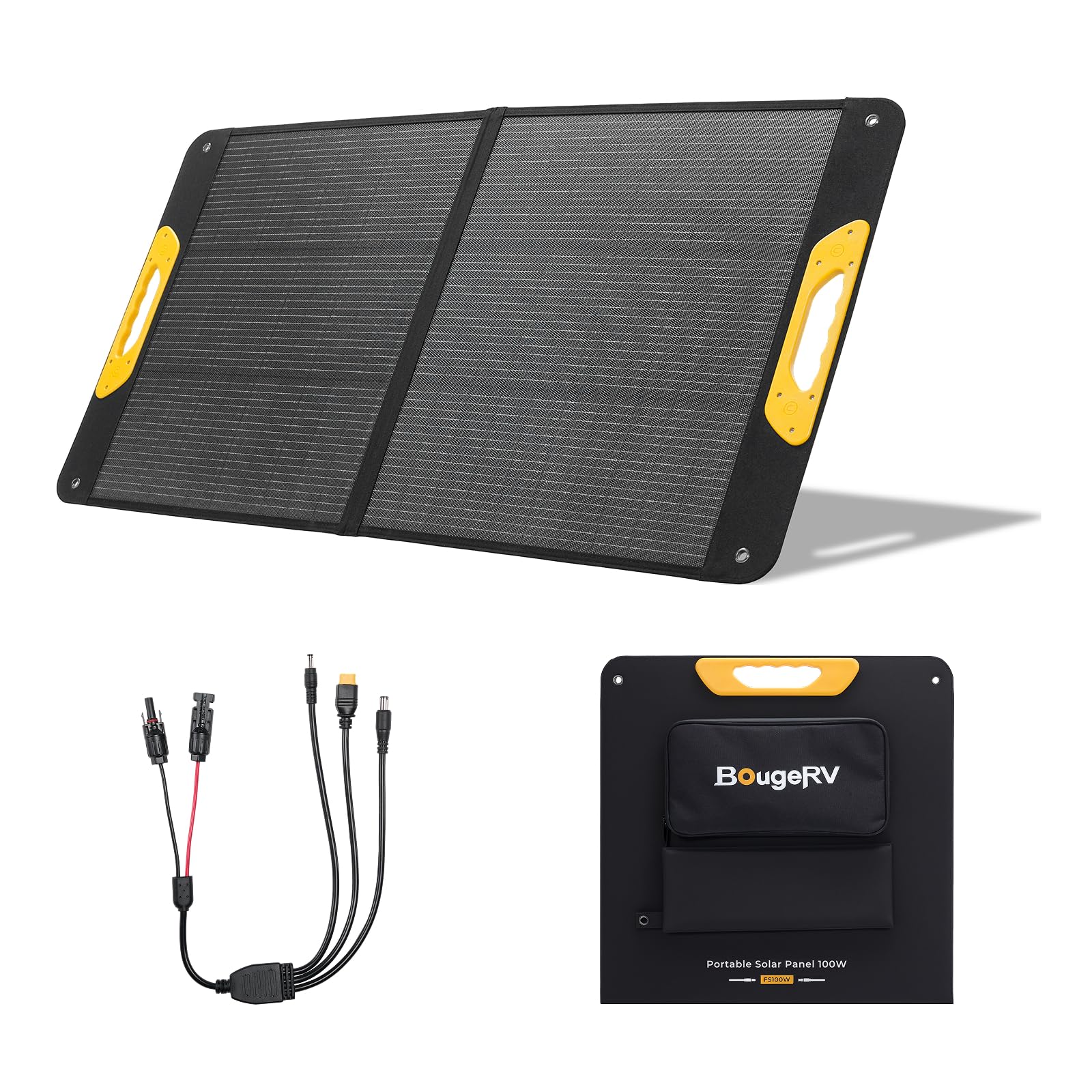
Our verdict
A fiberglass-backed 100W panel built to survive being thrown in a truck bed, at a reasonable 6.9 lb.
In stock · Last verified: 2026-08-28
We send you to Amazon and open your local store. A specific product may not be available in every country — if not, Amazon shows you a similar option.
Best for
- Overlanding and truck use
- Rough handling
- Panels that live in a vehicle
Not ideal for
- Minimum-weight setups
- Direct device charging
Pros
- Fiberglass backing resists cracking
- 6.9 lb is respectable for a rugged panel
- Monocrystalline cells with solid output
- Built for vehicles rather than cupboards
Cons
- Heavier than the ultralight options
- No USB output
- Ruggedness costs a little efficiency
Key specifications
| Rated output | 100 W |
|---|---|
| Backing | Fiberglass |
| Weight | 6.9 lb |
| Cell type | Monocrystalline |
| Best use | Overlanding, vehicles |
Alternatives
Renogy · Renogy 100W N-Type
A known brand at 25% efficiency and 7.3 lb, the safe default of the group.
Comparison →HQST · HQST 100W Ultralight
At 5 lb it's the lightest rigid-frame panel here, with the same N-type cells.
Comparison →View full analysis
Why we recommend it
Most portable panels fail at the hinges and the backing rather than the cells. BougeRV's fiberglass construction is aimed squarely at that: it flexes rather than cracking, and it shrugs off the knocks that come from living in a vehicle rather than a cupboard. At 6.9 lb it's not the lightest, but for overlanding and work-site use the durability is worth more than a pound saved.
Buying advice
This is the panel to buy if yours will live in the back of a vehicle. If it will live in a cupboard and come out for weekends, a lighter panel makes more sense and costs less.
Frequently asked questions
- Why does fiberglass matter?
- It flexes instead of cracking, which is what usually kills a panel that gets knocked around in a vehicle.
- Can I drive with it strapped outside?
- It handles knocks better than most, but no portable panel is designed for sustained highway wind. Carry it inside.
- Does ruggedness cost output?
- Slightly. You give up a few percent of efficiency compared with the lightest high-efficiency panels.